


It’s a fair question to be sitting with at midnight, phone in hand, when do gallstones need surgery, and is this my moment? The direct answer: surgery becomes necessary when stones start causing repeated pain, infection, a blocked bile duct, pancreatitis, or when they’re simply too large to leave alone safely. If your stones are silent and never cause symptoms, surgery usually isn’t needed at all. But once your gallbladder starts making real, recurring noise that’s usually your body asking for the operation, not just a change in diet.
Let’s go through exactly which situations tip the scale toward surgery, which don’t, and how that decision actually gets made.
Not All Gallstones Need Surgery: Silent vs Symptomatic Stones
This is worth saying plainly, because it gets missed often: having gallstones does not automatically mean you need an operation.
- Silent stones found by accident during an unrelated scan, causing no pain, no fever, nothing. Many people carry these for years without issue.
- Symptomatic stones are the ones causing actual pain, digestive trouble, or complications.
Doctors generally don’t rush silent stones into surgery. They monitor. Symptomatic stones are a different story altogether especially once the pain starts repeating itself. That repetition is usually the real trigger point, not the stones’ mere existence.

How Do You Know If Gallstones Are Serious?
This is the question underneath all the searching: is what I’m feeling actually serious, or can it wait?
A few patterns usually mean things have moved past “watch and wait”:
- Pain that keeps returning, especially after fatty meals
- Pain that lasts several hours instead of settling in 30–60 minutes
- Fever or chills alongside the pain
- Yellowing of the skin or eyes
- Vomiting that won’t stop, or pain so severe you can’t find a comfortable position
- Pain that used to be mild but is clearly getting worse or more frequent over weeks
Any one of these, especially fever or jaundice, is your cue to stop guessing and get evaluated properly. Mild, one-off discomfort that fades on its own is far less urgent than a pattern that keeps repeating or escalating.
5 Situations When Gallstones Need Surgery
Here are the five clinical situations doctors actually watch for when deciding whether gallstones have crossed into surgical territory.
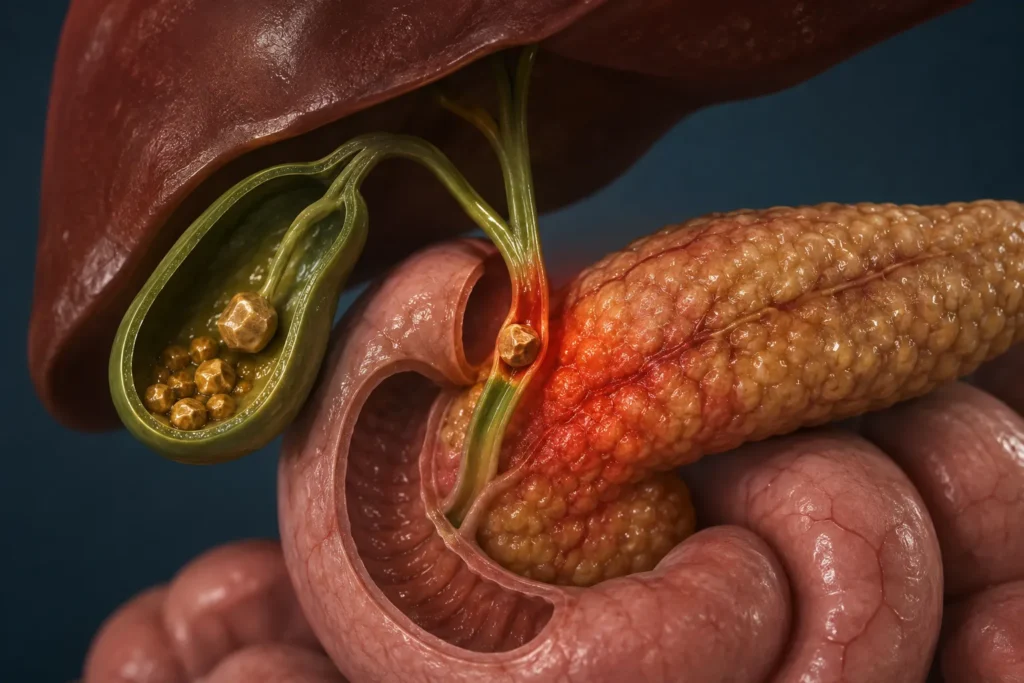
1. Recurrent Pain (Biliary Colic)
A single episode of biliary colic doesn’t necessarily mean surgery today. But once the pain keeps coming back every few weeks, every month, always after the same kinds of meals that pattern itself is the indication. Recurrent attacks mean the stones are actively causing trouble, and each episode carries a small risk of turning into something more serious.
2. Acute Cholecystitis (Gallbladder Inflammation)
When a stone blocks the gallbladder’s outlet and stays stuck, the gallbladder wall can become inflamed and infected with a condition called acute cholecystitis. This shows up as severe, constant pain (not the come-and-go kind), fever, and tenderness when the area is pressed. This almost always needs surgery, often sooner rather than later, to prevent the gallbladder from rupturing or the infection from spreading.
3. Blocked Bile Duct (Obstructive Jaundice)
Sometimes a stone doesn’t stay in the gallbladder; it travels into the main bile duct and blocks it entirely. This causes obstructive jaundice: yellowing skin and eyes, dark urine, and pale stools. This situation typically needs urgent intervention, sometimes an endoscopic procedure first to clear the duct, followed by gallbladder removal to prevent it from happening again.
4. Gallstone Pancreatitis
If a stone blocks the duct near where the pancreas drains, it can trigger gallstone pancreatitis inflammation of the pancreas itself. This causes severe, constant upper abdominal pain, often radiating straight through to the back, along with vomiting and a genuinely unwell feeling. This is a serious complication, usually requiring hospital admission and, once the acute episode settles, gallbladder removal to prevent it from happening again.
5. Large or Multiple Stones
Even without dramatic symptoms yet, very large stones (typically above 3cm) or a gallbladder packed with multiple stones carry a higher long-term risk of complications, including a rare association with gallbladder cancer. In these cases, doctors often recommend planned surgery rather than waiting for a painful attack to force the decision.
How Long Can Gallstones Be Left Untreated?
There’s no single, universal timeline here; it genuinely depends on what kind of stones you have and how they’re behaving.
- Silent stones can technically be left alone indefinitely, with periodic monitoring
- Occasional mild pain might be manageable for a while with dietary changes, though it often doesn’t stay mild forever
- Recurrent attacks shouldn’t really be left untreated for long each episode raises the odds of a complication
- Acute cholecystitis, jaundice, or pancreatitis are not “leave it” situations at all these need care within days, sometimes hours
The honest pattern doctors see again and again: patients who keep delaying symptomatic stones eventually end up needing emergency surgery under far more stressful, complicated circumstances than if they’d chosen a planned surgery earlier. Untreated doesn’t mean nothing happens. It usually just means the eventual problem gets bigger.
Non-Surgical Options: Do They Actually Work?
People understandably want to avoid surgery if there’s any real alternative. So, is there one?
- Oral dissolution medication (like ursodeoxycholic acid) can dissolve certain small cholesterol stones over many months, but it works slowly, doesn’t work for all stone types, and stones frequently come back once medication stops.
- Shock wave therapy (lithotripsy) to break stones is rarely used today for gallstones; it’s largely fallen out of favour due to poor long-term results.
- Dietary and lifestyle changes can reduce symptom frequency but won’t dissolve existing stones.
The honest truth: for symptomatic gallstones, laparoscopic cholecystectomy (surgical removal of the gallbladder) remains the most reliable, permanent solution. Non-surgical options have a narrow, specific role; they’re not a substitute for surgery once stones are actively causing problems.
When to See a Surgeon Instead of Waiting It Out
Some signs mean it’s time to stop self-managing and get a surgical opinion directly:
- You’ve had more than one attack of pain in recent months
- Your pain is getting more frequent or more intense over time
- You’ve had any fever alongside abdominal pain, even once
- You’ve noticed yellowing of your eyes or skin, even briefly
- A scan has already shown a large stone or a poorly functioning gallbladder
Waiting for the “worst possible” attack before seeing a surgeon usually means facing surgery in an emergency setting, rather than a calm, planned one. A planned laparoscopic surgery is almost always a smoother experience than an emergency one done at 3am.
Diagnosis Before the Surgery Decision

Before anyone recommends surgery, a proper diagnostic picture needs to be built. This usually includes:
- Ultrasound (USG) the first-line test, confirming stones and checking gallbladder wall thickness
- Blood tests to check for infection, liver function, and pancreatic enzymes
- MRCP used if a stone may have moved into the bile duct
- CT scan occasionally used to rule out complications
This isn’t just a formality. It’s what separates “you probably need surgery” from an actual, confident recommendation based on what’s really happening inside your body.
Deciding on Surgery With Meyash Hospital, Hisar
Once the diagnosis is clear, the conversation shifts to what’s actually best for you specifically. At Meyash Hospital, Hisar, this decision isn’t made off a single scan report in isolation; it’s based on your full symptom history, how often attacks are happening, and what the imaging shows.
When surgery is the right call, it’s performed through advanced laparoscopic technique gallbladder removal through a few small keyhole incisions rather than one large cut. That typically means less post-operative pain, a shorter hospital stay, and a quicker return to normal life compared to older open-surgery methods.
How Dr. Yashpal Singla Evaluates Whether You Actually Need Surgery
Not every patient walking in with gallstones needs to walk out scheduled for surgery. Dr. Yashpal Singla approaches each case individually looking at symptom frequency, stone size, gallbladder wall condition, and any signs of complications, rather than applying a blanket rule. For some, that means reassurance and monitoring. For others, it means a clear, honest recommendation that surgery is the safer path forward. Either way, the goal is a decision that actually fits your situation, explained in a way that makes sense to you.
What Happens If You Keep Delaying
It’s tempting to keep pushing surgery down the road, especially when the pain fades between attacks. But delaying symptomatic gallstones carries real risk:
- Attacks tend to become more frequent and more severe over time
- Risk of acute cholecystitis, jaundice, or pancreatitis rises with each episode
- What could have been a planned, low-risk surgery can turn into an emergency operation
- Emergency surgery generally carries higher risk and a longer recovery than planned surgery
None of this is meant to scare you into a decision. It’s meant to be honest about the trade-off: waiting doesn’t make the stones disappear, it usually just changes the circumstances under which you eventually deal with them.
Conclusion
Gallstones don’t all demand surgery; plenty of people live comfortably with silent stones for years. But once pain becomes recurrent, once fever or jaundice enters the picture, or once a stone is simply too large to ignore, surgery stops being optional and becomes the safer, smarter path. Knowing exactly when gallstones need surgery means you get to make that decision calmly, on your own timeline, instead of being forced into it during an emergency.
Ready to get treated?
If your gallstones need surgery and attacks are becoming frequent or severe, don’t wait for an emergency to force the decision. Dr. Yashpal Singla at Meyash Hospital, Hisar offers expert evaluation and advanced laparoscopic gallbladder surgery. Book your consultation today.
FAQs
Q: How will I know if my gallstones need surgery?
If you’re having recurrent pain, fever, jaundice, or a large stone on imaging, that usually points toward surgery. A proper evaluation with ultrasound and symptom history will confirm whether removal is truly needed.
Q: How long can you keep before gallstones need surgery?
Silent stones can be left alone indefinitely with monitoring. But once symptoms begin and repeat, waiting too long raises the risk of complications, so evaluation is best done soon after the first recurring attack.
Q: Can medication dissolve requirement of gallstones need surgery?
Certain small cholesterol stones can sometimes be dissolved with oral medication, but it works slowly, isn’t effective for all stone types, and stones often return once treatment stops. Surgery remains more reliable long-term.
Q: Is surgery always recommended for large gallstones need surgery even without pain?
Often yes, especially for very large stones or a gallbladder packed with stones, since these carry higher long-term complication risk. Your surgeon will weigh stone size against your overall health before recommending planned surgery.
Q: What happens if a gallstone attack is ignored?
Ignoring repeated attacks can lead to complications like acute cholecystitis, jaundice, or pancreatitis. What might have been a simple planned surgery can turn into an urgent, higher-risk emergency operation.
Q: Is emergency gallstones need surgery covered under cashless insurance at Meyash Hospital?
Emergency gallstone surgery is commonly covered under most health insurance plans, with cashless facilities available depending on the insurer. It’s best to confirm your specific policy details with the Meyash Hospital, Hisar team directly.
This article has been reviewed by the medical team at Meyash Hospital, Hisar. For personalized advice, consult Dr. Yashpal Singla or our specialists directly.