

There’s a particular kind of worry that comes with noticing a bulge somewhere it shouldn’t be in the groin, near the belly button, along an old scar and then spending the next few nights googling it instead of asking anyone out loud. So here’s the direct answer, before anything else.
Hernia surgery is the procedure used to push displaced tissue or organs back into place and repair the weak spot in the muscle wall that let it push through in the first place usually with a mesh reinforcement so the same weak spot doesn’t give way again.
It’s one of the most common surgeries performed worldwide, which sounds almost dismissive to say when you’re the one lying awake worrying about it, but it’s true, and it’s actually reassuring once you sit with it. Surgeons see this constantly. It’s rarely the mystery it feels like at 1am.
Hernias don’t heal on their own, and they don’t really go away with exercise or belts or willpower, however much that gets suggested online. But for the vast majority of people, treating one is a well-understood, well-practiced procedure with a good outcome and a clear recovery timeline, not the vague, frightening unknown it can feel like from the outside.
What Is a Hernia? And What Is Hernia Surgery?
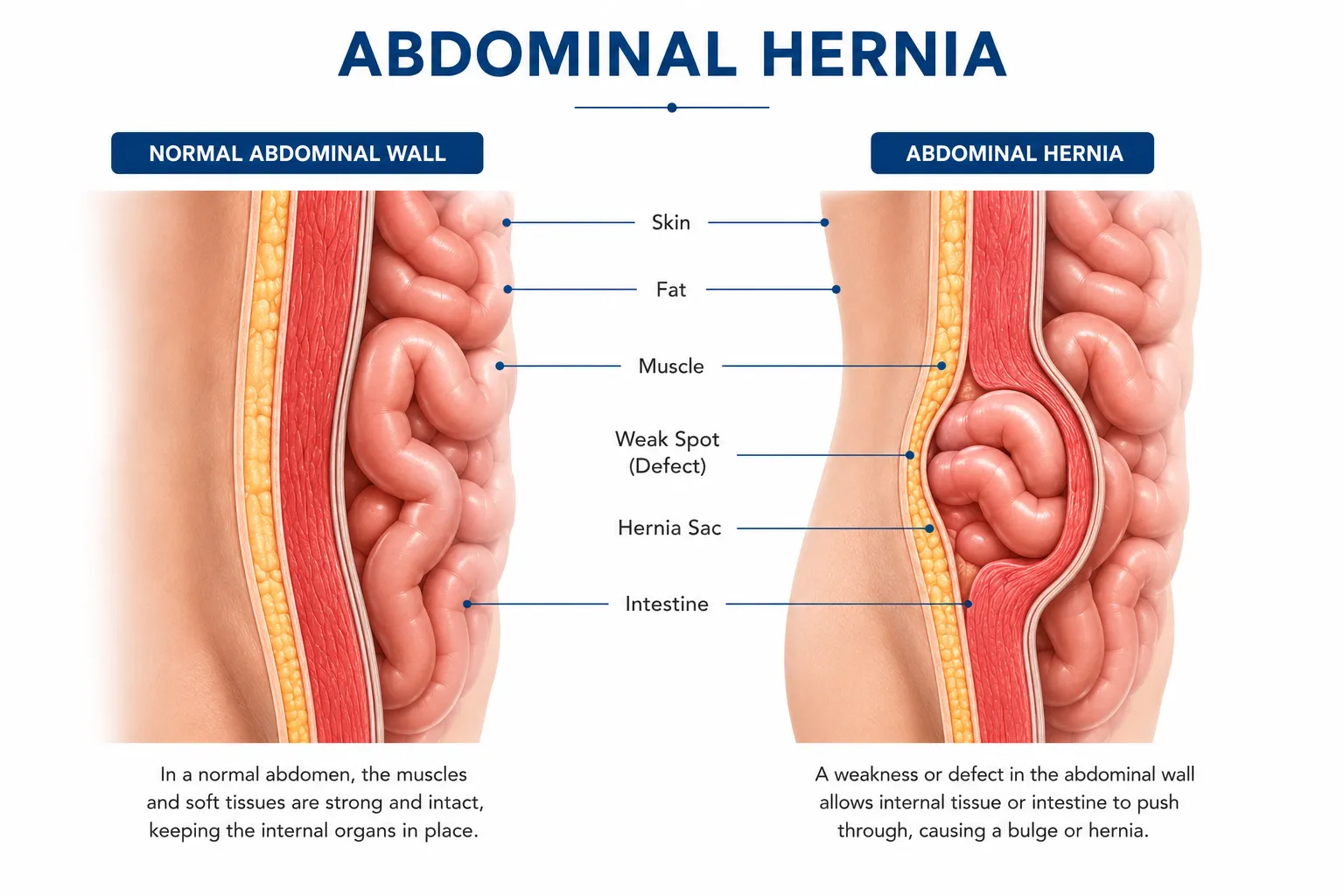
A hernia happens when an internal part of your body, usually a piece of intestine or fatty tissue, pushes through a weak spot in the surrounding muscle or connective tissue. Most commonly this shows up as a soft bulge somewhere in the abdomen or groin,
one that might get more noticeable when you cough, stand for a while, or strain, and settle back down when you lie flat and relax.
Hernia surgery is simply the repair of that weak spot. The surgeon gently returns the displaced tissue to where it belongs, then reinforces the area almost always with a thin synthetic mesh so the muscle wall has real support going forward, not just a stitched-together patch that’s likely to give way again under the same pressure that caused the problem the first time.
What Is the Main Cause of Hernia?
There’s rarely one single moment that causes a hernia, even though it often feels that way “I lifted that box and then noticed the bulge the next day.” What actually happened is usually a weak spot that had been building for a while, and that particular moment of strain was simply what finally pushed things through.
Weak Abdominal Muscles (Age, Birth, or Prior Surgery)
Some people are simply born with a slightly weaker area in the abdominal wall, often near the groin or belly button, that stays fine for years until age, weight change, or strain finally catches up with it. As muscle tone naturally declines with age, that weak spot becomes more likely to give way even without any dramatic trigger.
A previous surgical incision can also leave a permanently weaker point in the muscle layer, which is exactly why incisional hernias tend to show up months or even years after an earlier operation, sometimes long after the original scar has completely faded from memory.
Heavy Lifting and Straining
Repeated heavy lifting at work, at the gym, moving furniture puts real pressure against the abdominal wall. Combined with an already weak spot, that pressure is often the final trigger, even if the lifting itself felt completely normal at the moment.
This is part of why hernias are so common among people doing physically demanding jobs, from construction work to farming, where repetitive strain builds up over years rather than happening in one obvious moment.
Chronic Cough or Constipation
Anything that repeatedly increases pressure inside the abdomen adds up over time. A long-standing smoker’s cough, chronic constipation that involves regular straining, even certain respiratory conditions all quietly stress the same muscle wall, week after week, until it gives.
It’s a slow, cumulative kind of damage, which is exactly why it rarely feels connected to any single event when the hernia finally appears.
Obesity and Pregnancy
Extra abdominal weight puts sustained pressure on the muscle wall, which is part of why obesity is a well-established hernia risk factor. The more weight the abdominal muscles have to support continuously, the more likely a weak point is to eventually fail.
Pregnancy works similarly the abdominal muscles stretch considerably to accommodate a growing uterus, and umbilical hernias in particular become noticeably more common during and after pregnancy, especially with multiple pregnancies close together.
Types of Hernia
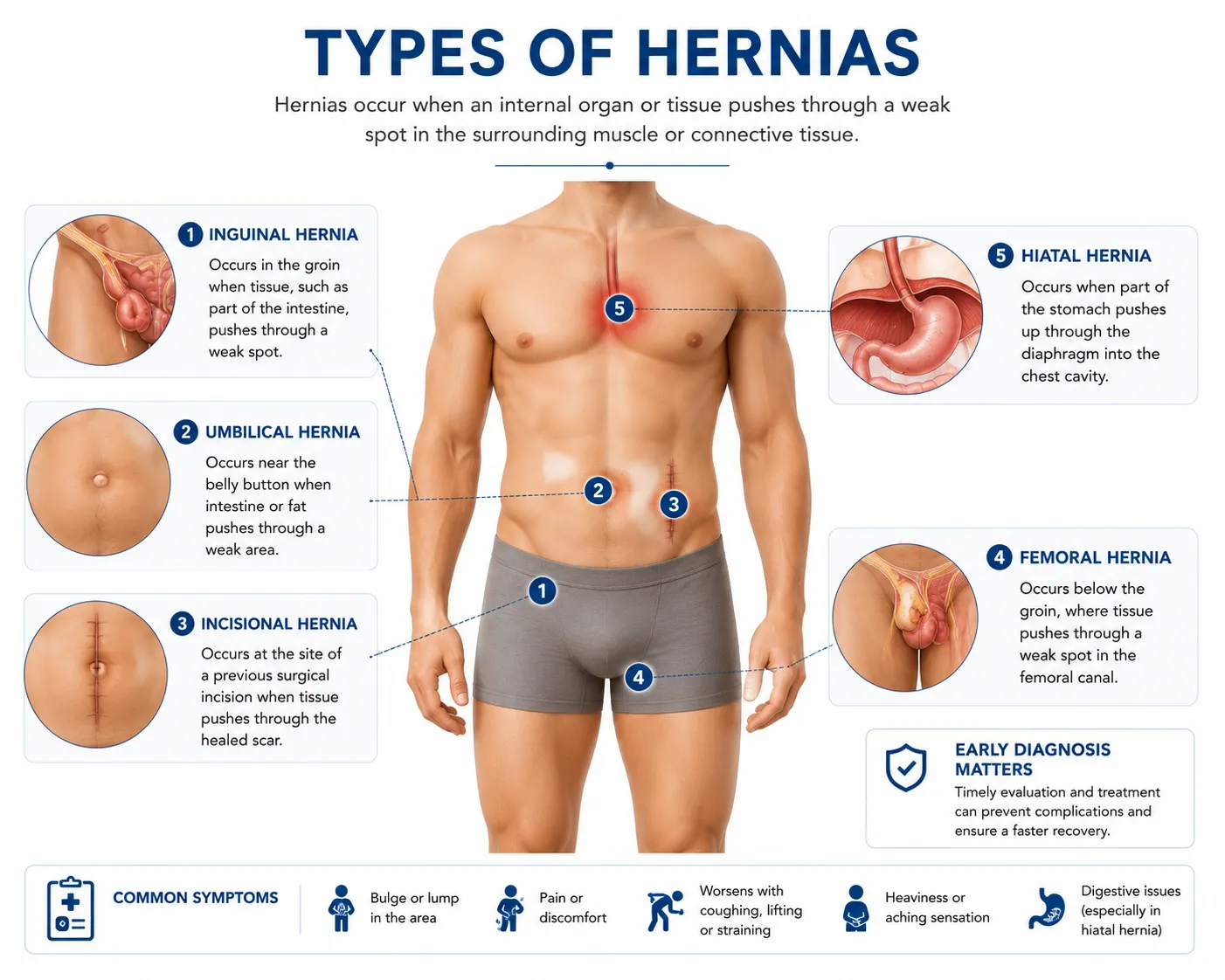
1. Inguinal Hernia
The most common type by a wide margin, accounting for the large majority of all hernia cases, occurring in the groin where the abdominal wall is naturally a little weaker. It’s far more frequent in men, largely due to how the inguinal canal is structured around the natural passage that the testicles descend through before birth, though women can develop it too.
2. Umbilical Hernia
Appears near the belly button, where the abdominal wall closes after birth sometimes not quite completely. It shows up in infants, where it often closes on its own within the first few years, but also in adults, especially after pregnancy or significant weight gain, where it generally doesn’t resolve without repair.
3. Incisional Hernia
Develops at the site of a previous surgical incision, where the muscle layer never fully regained its original strength. These can appear months or years after the original operation, sometimes catching patients completely off guard, and they tend to require particular surgical attention because the tissue around an old scar behaves differently than untouched muscle.
4. Femoral Hernia
Occurs just below the groin crease, in the femoral canal, and is more common in women than inguinal hernias are. It carries a somewhat higher risk of becoming strangulated compared to other hernia types, which is one reason doctors tend to recommend prompt treatment rather than a watch-and-wait approach.
5. Hiatal Hernia
A different category altogether this one happens when part of the stomach pushes up through the diaphragm into the chest cavity, and it’s closely linked to chronic acid reflux rather than a visible external bulge. It’s diagnosed and managed quite differently from the abdominal wall hernias described above.
6. Recurrent or Complex Hernia
A hernia that returns after a previous repair, or one involving a larger defect, multiple hernias at once, or scar tissue from earlier surgery. These cases generally call for a more experienced surgical hand, since the anatomy is rarely as straightforward the second time around, and the approach often needs to account for whatever mesh or scarring is already present from the first surgery.
Symptoms of Hernia When a Bulge Becomes an Emergency
The most obvious sign is exactly what you’d expect: a bulge that’s more noticeable when standing, coughing, or straining, and less noticeable lying down. Alongside that, people often describe a dull ache, a pulling sensation, or heaviness in the area, especially by the end of a long day on their feet.
Some notice it first as discomfort during exercise, or a strange tugging feeling while lifting something ordinary, well before any visible bulge shows up.
Warning Signs You Shouldn’t Ignore (Strangulated Hernia)
Occasionally, the protruding tissue gets trapped and loses its blood supply; this is called a strangulated hernia, and it’s a genuine emergency. Watch for a bulge that suddenly becomes hard, intensely painful, and doesn’t push back in the way it usually does, along with nausea, vomiting, or fever.
If this happens, it needs immediate medical attention, not a wait-and-see approach. This is one of the few hernia scenarios where a delay of even a few hours can matter.
Can You Live a Normal Life With a Hernia? (Risks of Waiting Too Long)
Technically, yes plenty of people live with a small, stable hernia for a while, adjusting how they lift things and keeping an eye on it. But “living with it” isn’t really the same as “it being fine,” and this is where a lot of people talk themselves into unnecessary risk, especially if the bulge isn’t causing much pain yet.
A hernia doesn’t heal itself, and it doesn’t stay the same size forever, either. Most tend to grow slowly over time as the weak spot continues to stretch, and a hernia that was easy to repair at a small size can become a genuinely harder, more complex repair once it’s larger, sometimes needing more mesh, a longer operation, and a longer recovery.
And there’s always the strangulation risk sitting quietly in the background, however small, which turns a planned, straightforward surgery into an emergency one, often performed under far less favorable conditions than a scheduled procedure would have been.
So the honest answer is: you can delay it for a while without immediate catastrophe, but delaying rarely makes things simpler, and it often makes the eventual surgery more complicated than it needed to be. Most surgeons would rather see a patient with a small, easily managed hernia sooner than a large, complicated one later.
Types of Hernia Repair Surgery
1. Open Hernia Repair
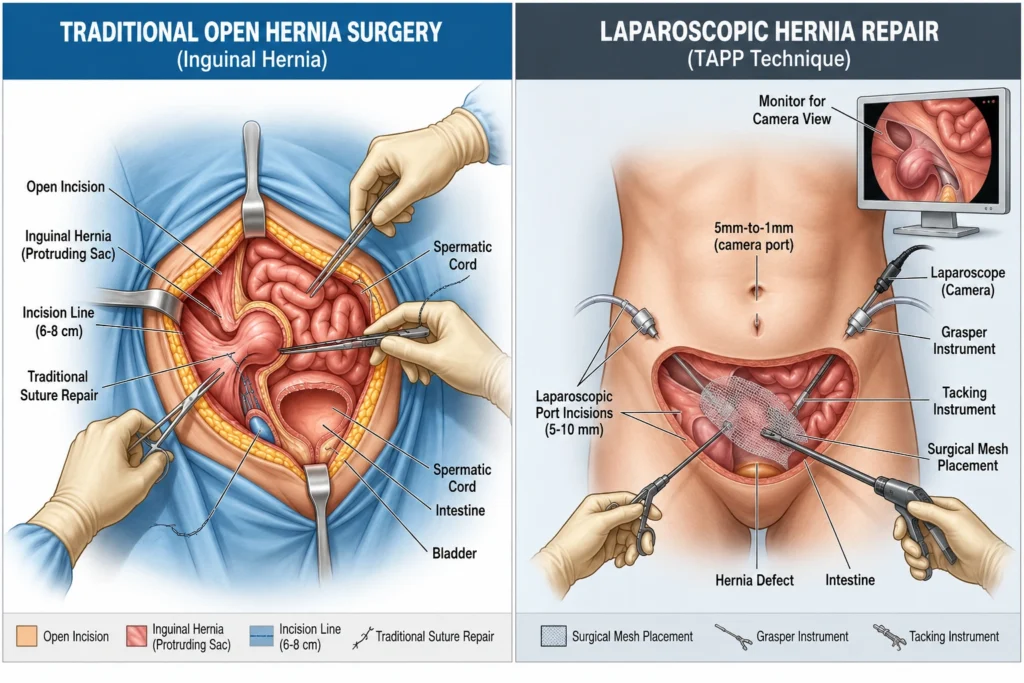
The traditional approach involves one incision directly over the hernia, through which the surgeon pushes the tissue back and repairs the muscle wall, usually with mesh. It’s still the right choice for certain large or complex hernias,
and it doesn’t require general anesthesia in every case, since some open repairs can be done under local or regional anesthesia depending on the patient and the hernia itself.
2. Laparoscopic Hernia Repair
Performed through a few small incisions using a camera and long instruments, this approach generally means less pain, a shorter hospital stay, and a faster return to normal activity compared to open repair.
It’s particularly useful for hernias on both sides of the body, since both can often be fixed through the same small incisions in one sitting, and it tends to be the preferred approach for recurrent hernias too, since it allows the surgeon to reinforce the area from behind the original repair.
3. Robotic Hernia Repair
A more recent variation of the laparoscopic technique, where the surgeon controls robotic arms with extremely fine precision useful for certain complex or recurrent cases where extra dexterity in tight spaces makes a real difference, particularly for hernias close to delicate structures.
4. Mesh vs Non-Mesh Repair
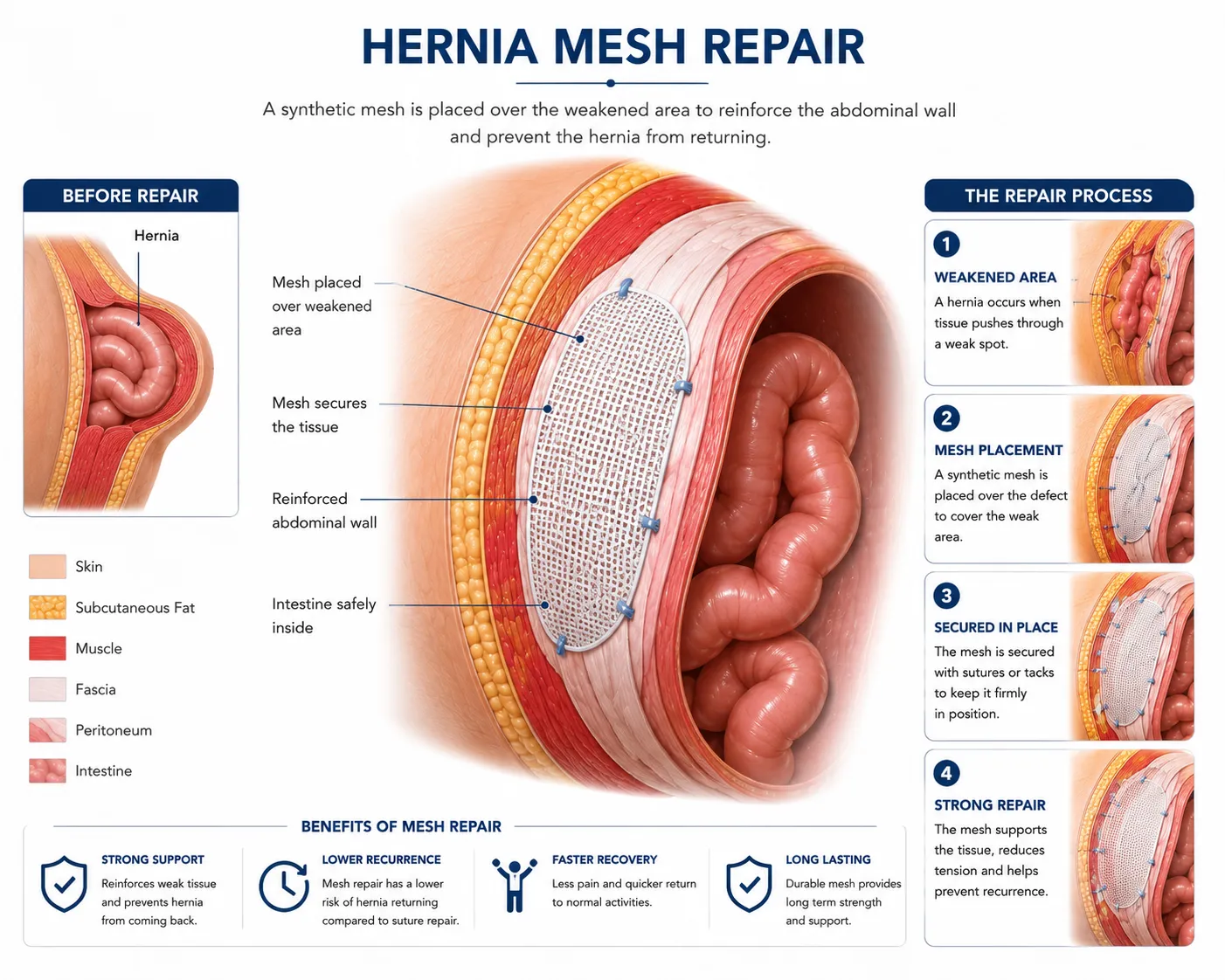
Mesh repair has become the standard for most hernias because it significantly lowers the chance of recurrence compared to stitching the muscle layer back together on its own (a technique still used occasionally for very small hernias or specific patient circumstances, such as certain pediatric cases).
The mesh itself is a thin, well-tolerated synthetic material that integrates with the surrounding tissue over the following weeks, essentially becoming a permanent reinforcement rather than a foreign object the body has to work around.
When to See a Doctor for a Hernia
If you’ve noticed a new bulge, one that’s growing, one that’s starting to ache more than it used to, or one that no longer pushes back in easily it’s time to get it looked at, even if it isn’t causing serious pain yet. And if that bulge suddenly becomes hard, intensely painful, or is accompanied by vomiting or fever, that’s not a “book an appointment for next week” situation.
That needs emergency care immediately.
Diagnosis of Hernia
Most hernias are diagnosed through a straightforward physical examination; a doctor will often ask you to stand, cough, or strain slightly to see the bulge more clearly. For hernias that are harder to feel, or when the diagnosis isn’t fully clear, an ultrasound or CT scan can confirm exactly what’s happening beneath the surface and help plan the right surgical approach.
Hernia Surgery Treatment at Meyash Hospital, Hisar
Hernia repair is one of the procedures performed most often at Meyash Hospital, and the approach leans heavily toward laparoscopic and minimally invasive hernia surgery wherever the case allows it because for most patients, that simply means an easier recovery for an equally effective repair.
The hospital’s operating theatres and surgical team are set up specifically for this kind of minimally invasive work, rather than treating it as an occasional add-on to general surgery.
Why Dr. Yashpal Singla for Complex and Recurrent Hernia Cases
Dr. Yashpal Singla has performed over 25,000 laparoscopic surgeries across his career, including a substantial volume of hernia repairs from straightforward first-time inguinal hernias to genuinely difficult recurrent and complex cases referred in after a previous repair elsewhere didn’t hold.
As Former HOD & Senior Consultant at Jindal Hospital, Hisar, and with 100,000+ patients treated overall, his experience covers exactly the range of complexity that hernia surgery can present, including cases where the anatomy has already been altered by earlier surgery.
What patients consistently mention isn’t just the technical outcome, it’s that every consultation happens directly with him, the plan is explained honestly, and there’s no pressure to rush into surgery if it isn’t genuinely needed yet.
For a decision that often comes with more anxiety than the surgery itself deserves, that honesty tends to matter as much as the surgical skill behind it.
Cost of Hernia Surgery in Hisar and Nearby Haryana
Hernia surgery cost depends on several factors whether it’s a straightforward single hernia or a recurrent, complex case, whether it’s done laparoscopically or as open surgery, the type of mesh used, and the length of hospital stay required.
A simple umbilical hernia repair and a complex recurrent inguinal hernia with prior mesh in place simply aren’t the same procedure, and the cost reflects that difference, much the way the surgical time and post-operative care needed for each differs too.
For patients across Hisar, Hansi, Barwala, and the wider Haryana region, Meyash Hospital’s empanelment with major insurers and TPAs Star Health, Care Health, Niva Bupa, HDFC ERGO, and the Haryana Government and Ayushman Bharat panels means cashless treatment is available for those who qualify.
The hospital’s billing team can confirm your specific coverage and walk you through the numbers before you commit to a surgery date, and flexible payment options are available for anyone paying out of pocket, so cost doesn’t have to be the reason a hernia goes untreated for longer than it should.
Recovery After Hernia Surgery
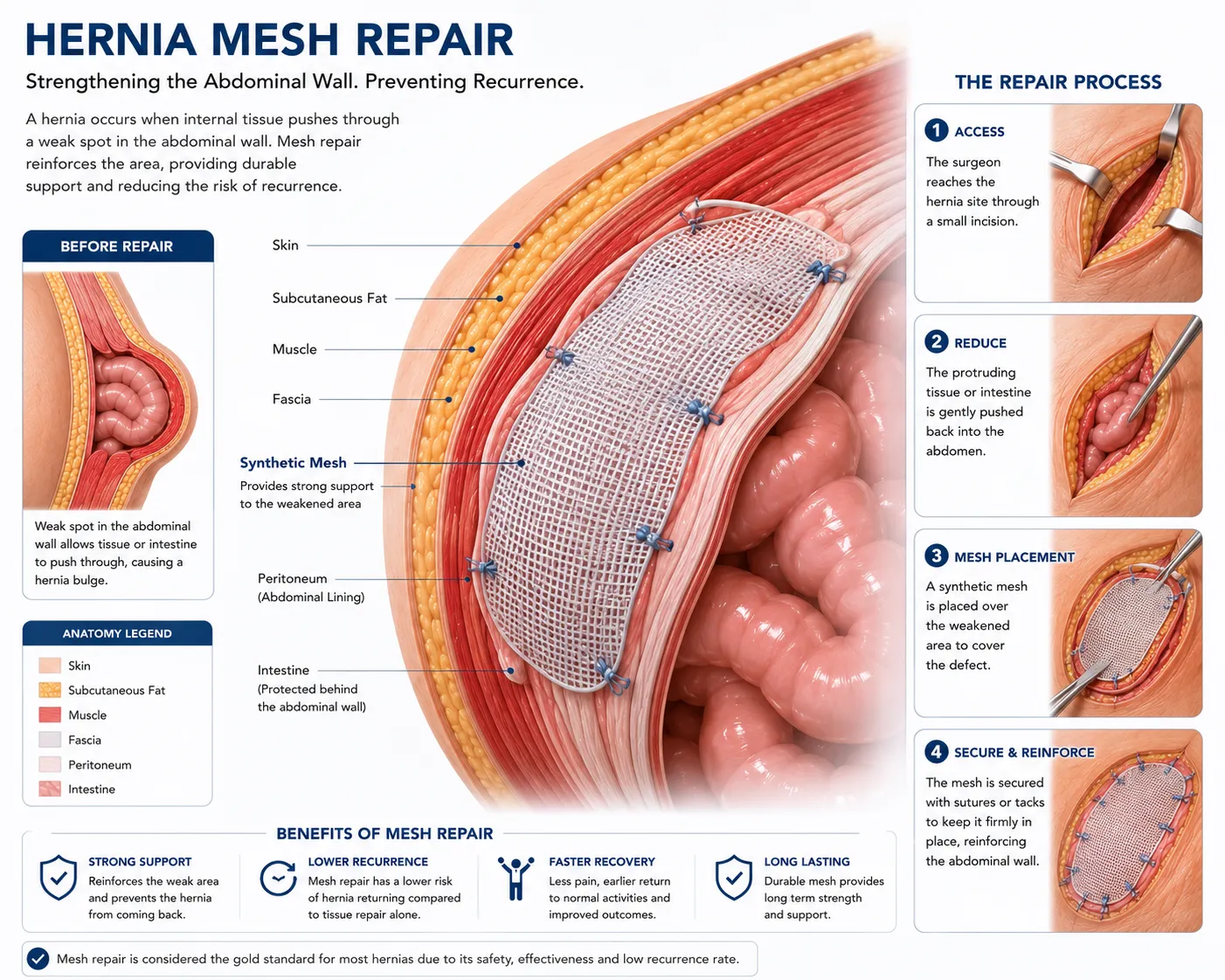
First 24 to 72 Hours
Expect some soreness around the incision site and general fatigue as the anesthesia wears off. Walking gently is encouraged almost immediately it actually helps circulation and recovery but lifting anything heavier than a few kilos is off the table for now.
Most laparoscopic hernia repairs involve going home the same day or after one overnight stay, whereas an open repair, especially for a larger hernia, may involve a slightly longer stay for monitoring.
Returning to Work and Lifting Restrictions
Desk-based work is usually fine within about a week for laparoscopic repairs, sometimes a little longer for open surgery. Heavy lifting and strenuous exercise need to wait longer, typically four to six weeks since the mesh needs time to properly integrate with the surrounding tissue before it’s tested with real strain again.
This waiting period isn’t arbitrary caution; it genuinely reflects how long the repair takes to reach its full strength.
Diet After Hernia Surgery
There’s no special hernia diet, but staying regular matters more than usual right after surgery, since straining during constipation puts direct pressure right where you’ve just been repaired. Fibre-rich food, plenty of water, and going easy on very heavy meals for the first few days all help keep things comfortable while you heal,
and your surgeon may suggest a mild stool softener for the first week or two as a precaution.
Can a Hernia Come Back After Surgery? (Recurrence Risk)

It’s possible, though modern mesh repair has made recurrence considerably less common than it used to be with older stitch-only techniques. Recurrence tends to happen for a few identifiable reasons, returning to heavy lifting too soon, a technical factor in how the original repair was done, or simply an unusually weak muscle wall in that particular patient.
This is really the core argument for going to an experienced hernia surgeon the first time around, since a well-done initial repair meaningfully lowers the odds of ever having this conversation again, and recurrent hernia surgery is generally more involved than the original procedure was.
Preventing Hernia Recurrence
Recovery doesn’t end the day you leave the hospital. A few simple habits in the weeks and months afterward make a real difference to whether the repair holds long-term.
- Follow your lifting restrictions properly during recovery, even once you’re feeling fine
- Maintain a healthy weight, since excess weight adds ongoing pressure to the repair
- Treat chronic cough or constipation rather than letting them strain the area repeatedly
- Use correct lifting technique going forward bending at the knees, not the waist
- Attend your follow-up appointments so any early issues get caught before they become bigger ones
Conclusion
A hernia is one of those problems that tends to feel much bigger at midnight than it actually is in a surgeon’s office. It’s common, it’s well understood, and for the overwhelming majority of patients, repairing it is a routine, well-practiced procedure with a genuinely good outcome. The sooner it’s addressed properly, the simpler that repair usually stays.
If you’ve noticed a hernia and have been putting off dealing with it, this is a good time to stop waiting. The team at Meyash Hospital, Hisar offers advanced laparoscopic hernia surgery, including complex and recurrent cases. Book your consultation today.
FAQs
Q1: How painful is hernia surgery?
Most patients describe manageable soreness for the first few days rather than severe pain, especially with laparoscopic repair. Pain medication and gentle movement both help it settle quickly.
Q2: Is hernia surgery a major surgery?
It’s a genuine surgical procedure under anesthesia, but for most patients particularly with laparoscopic repair it’s considered low-risk with a fairly quick recovery compared to many other surgeries.
Q3: Can a hernia be treated without surgery?
Not really. A hernia won’t close on its own, and while a support belt might ease discomfort temporarily, surgery is the only way to actually repair the weak spot causing it.
Q4: What happens if hernia surgery is delayed?
The hernia typically grows larger and can become harder to repair over time, and there’s always a small but real risk of strangulation, which turns a planned surgery into an emergency one.
Q5: Does hernia come back after surgery?
It’s possible, but mesh repair has made recurrence uncommon compared to older techniques. Following lifting restrictions during recovery significantly lowers the risk further.
Q6: Is hernia surgery covered under cashless insurance at Meyash Hospital?
Yes, Meyash Hospital is empanelled with major insurers and TPAs, including Star Health, Care Health, Niva Bupa, and the Haryana Government panel, so cashless treatment is available for eligible patients.
This article has been reviewed by the medical team at Meyash Hospital, Hisar. For personalized advice, consult Dr. Yashpal Singla or our specialists directly.