

It usually starts the same way. Pain after a heavy meal, somewhere under the right ribs, that you brushed off as gas the first two times. Then it happened again, sharper this time, maybe with some nausea thrown in, and now you’re here at midnight trying to figure out if this is something serious or just bad luck with dinner.
Maybe you’ve already had one bad night of it, doubled over, unable to get comfortable, wondering whether to go to the emergency room or just wait it out.
Here’s the direct answer. Gallbladder surgery, medically called a cholecystectomy, is the removal of the gallbladder, usually because of gallstones causing repeated pain, inflammation, or blockages. It’s one of the most commonly performed surgeries in the world, done laparoscopically in the vast majority of cases these days,
and the gallbladder itself, while useful, isn’t an organ you actually need to live a completely normal life without.
That pain now has a name, and a very well-established solution behind it. This isn’t rare or mysterious territory for a surgeon, it’s one of the most routine procedures in general surgery. Let’s go through what’s actually happening, when surgery becomes the right call, and what life looks like on the other side of it.
What Is Gallbladder Surgery (Cholecystectomy)?
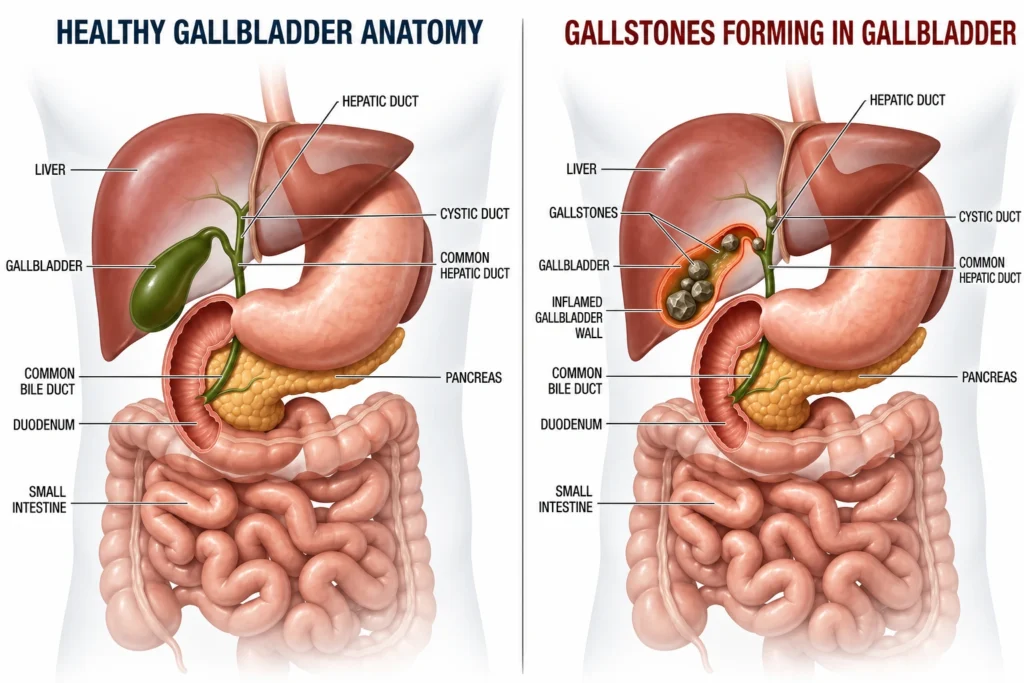
The gallbladder is a small, pear-shaped organ tucked away under the liver, whose main job is storing and concentrating bile, a digestive fluid the liver produces to help break down fat. Most of the time it does this job quietly, without you ever thinking about it, until gallstones start forming inside it and causing trouble.
Bile itself doesn’t stop being produced when this happens; it’s the storage and release process that gets disrupted, which is exactly why the symptoms tend to show up after fatty meals specifically, when the gallbladder is normally called on to contract and release a concentrated dose of bile into the small intestine to help digest that meal.
This procedure removes the organ entirely, rather than trying to remove individual stones and leave the gallbladder in place. That might sound drastic at first, but it’s actually the more reliable option, since gallstones tend to keep forming in a gallbladder that’s already prone to them,
removing the whole organ prevents the same problem from simply recurring a year or two later, which is exactly what tends to happen with stone-removal-only approaches that leave the underlying organ in place.
Conditions That Require Gallbladder Surgery
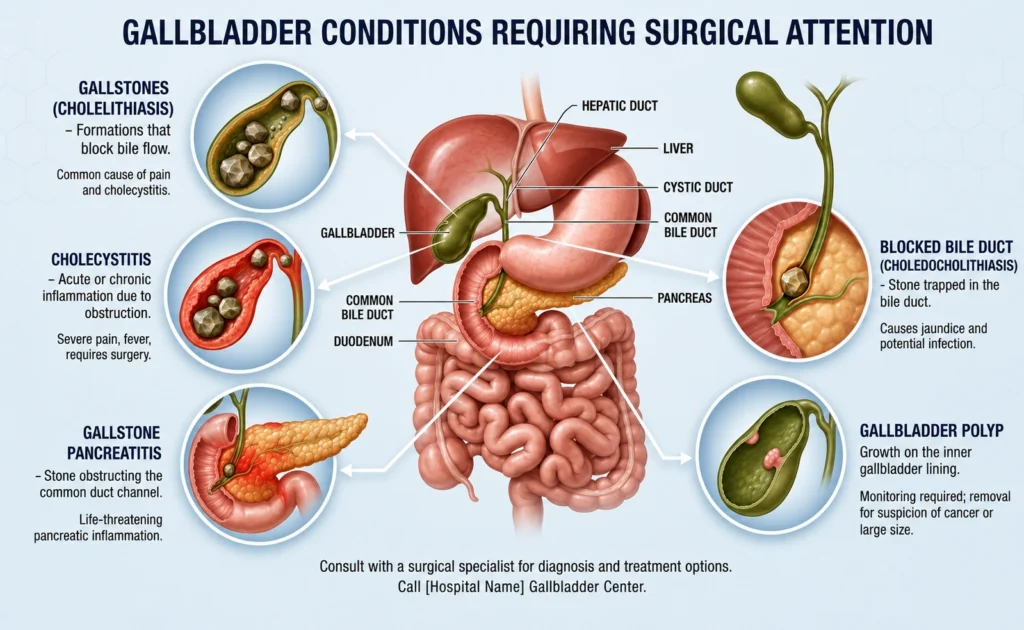
Not every gallbladder problem looks the same, and the specific condition often shapes how urgently surgery gets recommended.
1. Gallstones (Cholelithiasis)
The most common reason surgery gets recommended. These are hardened deposits, usually made of cholesterol or bilirubin, that form inside the gallbladder and can block the flow of bile, causing sharp pain, especially after fatty meals.
Not everyone with gallstones needs surgery immediately, many people have “silent” gallstones that never cause symptoms, but once they start causing recurring pain, surgery is usually the recommended path rather than waiting for the next, potentially worse, episode.
2. Gallbladder Inflammation (Cholecystitis)
When a gallstone blocks the duct leading out of the gallbladder, the trapped bile can cause inflammation and infection. This tends to be more painful and more urgent than uncomplicated gallstones, often accompanied by fever and a genuinely tender abdomen, and it’s often what pushes a “manage it for now” situation into a “this needs surgery soon” one.
3. Gallstones in the Bile Duct (Choledocholithiasis)
Sometimes a stone escapes the gallbladder and lodges in the bile duct itself, which can cause jaundice, more severe pain, and a higher risk of complications like pancreatitis. This usually needs an additional procedure, often an ERCP, a specialized endoscopic technique, alongside gallbladder removal to clear the duct completely.
4. Gallbladder Polyps
Growths on the gallbladder wall that are usually harmless, but larger ones, or those that grow over time, carry a small risk of becoming cancerous, which is why surgery is often recommended once a polyp crosses a certain size threshold, typically around one centimeter, or shows changes on repeated imaging.
5. Gallstone Pancreatitis
When a gallstone blocks the duct shared by the gallbladder and pancreas, it can trigger pancreatitis, a serious, painful inflammation of the pancreas that often requires hospital admission on its own.
This is treated as urgent, and gallbladder removal is usually recommended once the acute pancreatitis has settled, to prevent it from happening again with the next stone.
6. Suspected Gallbladder Cancer
Rare, but when imaging raises concern for cancer, surgery is used both to treat it and to get a definitive diagnosis through tissue examination, since gallbladder cancer is difficult to confirm through imaging alone.
Symptoms of Gallstones and Gallbladder Disease
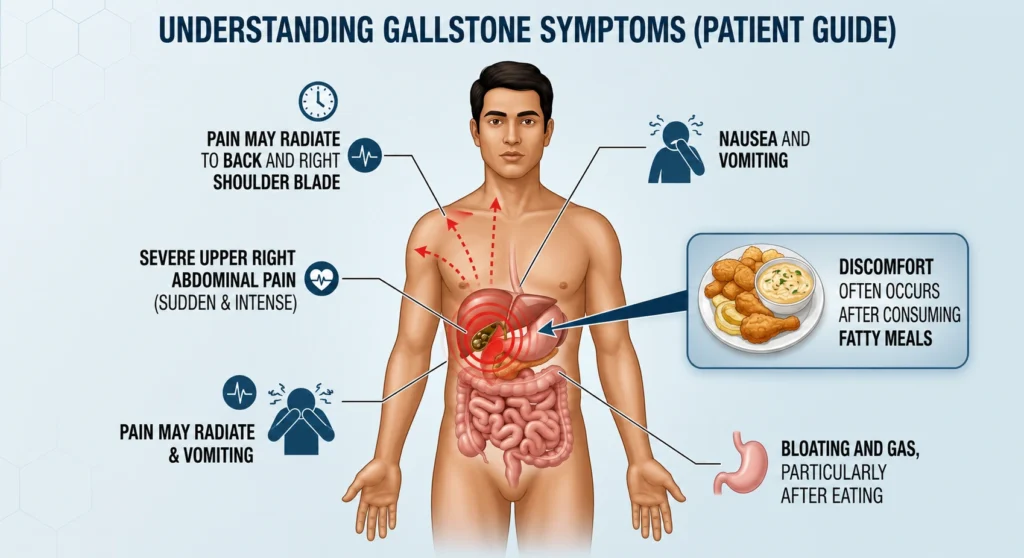
The classic symptom is pain in the upper right or center of the abdomen, often triggered or worsened after a fatty or heavy meal, sometimes radiating toward the right shoulder blade or back.
Nausea, bloating, and a general feeling of discomfort after eating are common companions to that pain, and episodes can last anywhere from a few minutes to several hours before easing off on their own, often described as coming in waves rather than one continuous ache.
Warning Signs of a Gallbladder Attack
Some signs mean it’s time to stop waiting and get seen urgently: pain that doesn’t ease after a few hours, fever accompanying the abdominal pain, yellowing of the skin or eyes (jaundice), dark urine, or pain severe enough that you can’t get comfortable in any position.
These can point to a blocked duct, infection, or inflamed gallbladder that needs prompt attention rather than a wait-and-see approach, and delaying care in these situations can allow a straightforward problem to become a genuinely complicated one.
How Does Life Change After Gallbladder Removal?
Honestly, less than most people expect going in. The gallbladder stores and concentrates bile, but it isn’t the only thing standing between you and normal digestion. Once it’s removed, the liver still produces bile continuously, and it simply flows more directly into the intestine instead of being stored and released in concentrated bursts around meals.
For most patients, day-to-day life returns to essentially normal within a few weeks. Some people notice slightly looser stools for a while after very fatty meals, since bile is now less concentrated when it reaches the intestine, but this tends to settle as the digestive system adjusts, often within a couple of months.
A small number of patients find they need to be a bit more mindful of very rich, greasy food long-term, but this is more of a minor adjustment than a major lifestyle overhaul, and plenty of patients report no noticeable dietary change at all once they’re fully healed.
Meals out, festivals, family cooking, none of that has to change in any significant way for the vast majority of people who’ve had this surgery.
Types of Gallbladder Surgery
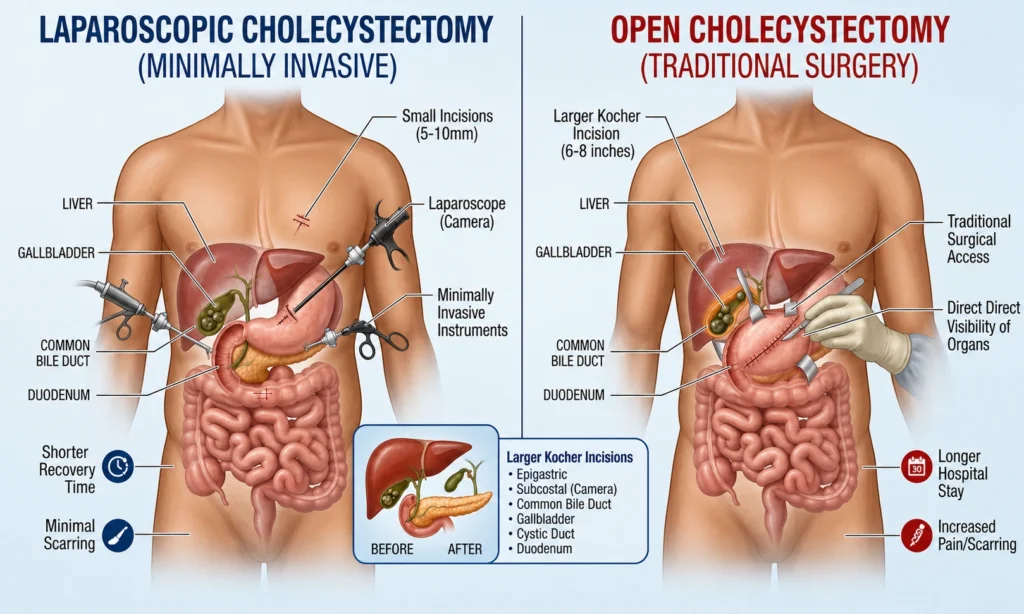
1. Laparoscopic Cholecystectomy
The standard approach today for the large majority of cases, performed through three or four small incisions using a camera and surgical instruments. It typically means a same-day or overnight hospital stay, less post-operative pain, and a return to normal activity within one to two weeks,
which is exactly why it’s become the default choice wherever a patient’s anatomy and condition allow for it.
2. Open Cholecystectomy
Reserved now mostly for complex cases, severe inflammation, extensive scarring from previous surgeries, or situations where a laparoscopic approach isn’t safe to complete once the surgeon is already inside. This involves a larger incision and a longer recovery, generally several weeks, but remains an important option when the anatomy or complications call for it,
and occasionally a laparoscopic procedure is converted to open surgery mid-operation if the surgeon determines it’s the safer path forward.
What Happens During Gallbladder Surgery
For a laparoscopic procedure, you’ll be given general anesthesia and positioned on the operating table, after which the surgeon makes three or four small incisions in the abdomen. The abdomen is gently inflated with carbon dioxide gas to create working space, a camera goes in through one incision, and the surgical instruments go in through the others.
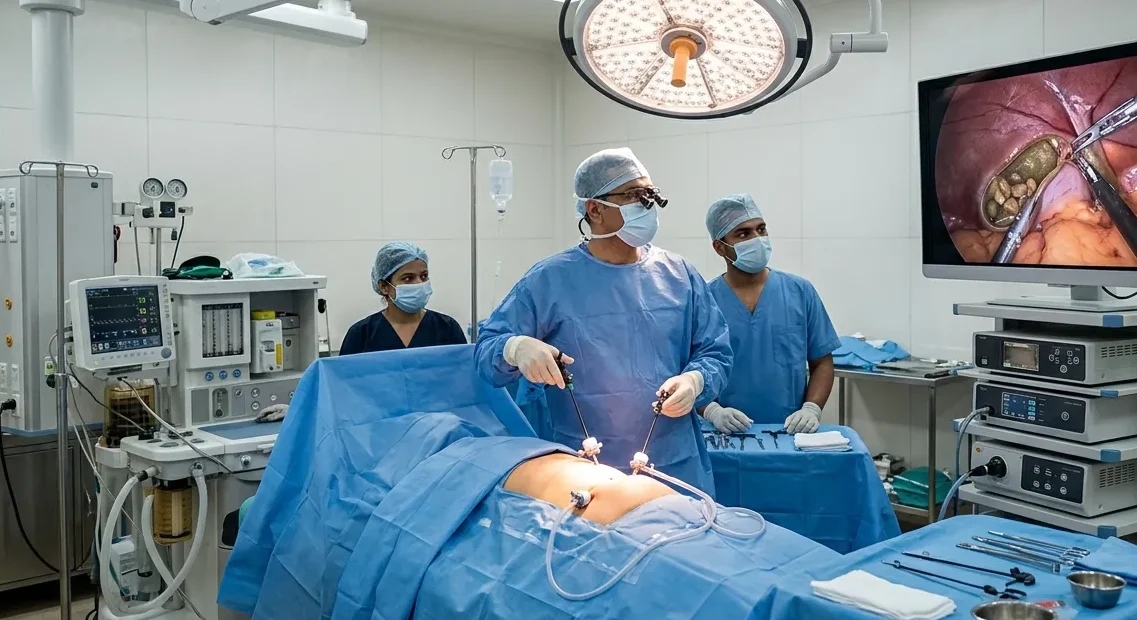
The surgeon carefully separates the gallbladder from the liver and surrounding tissue, clips off the duct and artery supplying it, and removes the entire organ through one of the small incisions.
The whole procedure typically takes about one hour for straightforward cases, longer if there’s significant inflammation or scarring to work around carefully. Once the gallbladder is out, the gas is released, incisions are closed, and you’re moved to a recovery area to wake up from anesthesia before either heading home the same day or staying for one night of observation.
Throughout the procedure, an anesthesiologist monitors your vitals continuously, and the surgical team confirms the anatomy carefully before any structure is cut or clipped, which is exactly the kind of caution that experience makes second nature.
Can You Live Without Your Gallbladder? Digestion After Surgery
Yes, completely, this is one of those organs where “essential” doesn’t quite apply the way it does for a kidney or the liver itself. Millions of people live full, unrestricted lives without a gallbladder, and most don’t think about its absence at all once the recovery period is behind them. Athletes, people with physically demanding jobs,
new parents managing irregular meal schedules, none of that is meaningfully affected long-term by the absence of a gallbladder.
What actually happens is that bile production continues exactly as before; only the storage step is removed from the process. Instead of being held and concentrated between meals, it drips more continuously from the liver into the small intestine.
Digestion still works, it’s just a slightly different rhythm than before, one your body typically adapts to within a matter of weeks. The occasional looser stool after an unusually greasy meal is about as far as the long-term difference tends to go for most people, and even that tends to fade as the months go by.
When to See a Doctor for Gallstones
If you’ve had more than one episode of upper abdominal pain after eating, especially if it’s happening more frequently or lasting longer each time, that’s worth getting checked rather than continuing to manage with antacids and hoping it settles on its own.
Repeated episodes are usually a sign that the underlying cause, gallstones, isn’t going anywhere, and each attack carries some risk of becoming the one that doesn’t resolve quietly on its own, without medical help. And if you develop fever, jaundice, or pain severe enough to stop you in your tracks,
that’s not something to wait out at home, that needs urgent medical attention, ideally the same day rather than “let’s see how tomorrow goes.”
Diagnosis of Gallbladder Disease
An abdominal ultrasound is usually the first and most useful test, since it shows gallstones clearly and can also reveal thickening or inflammation of the gallbladder wall. It’s a quick, painless scan, and for most patients, it’s all that’s needed to confirm the diagnosis.
Blood tests can check for signs of infection, inflammation, or a blocked bile duct, and in more complex cases, a CT scan or specialized MRI (called an MRCP) may be used to get a clearer picture of the bile ducts specifically, particularly if a stone is suspected to have moved beyond the gallbladder itself.
Gallbladder Surgery Treatment at Meyash Hospital, Hisar
Laparoscopic cholecystectomy is among the most frequently performed procedures at Meyash Hospital, supported by an operating setup built specifically for minimally invasive general surgery and a team experienced in handling both straightforward and genuinely complicated gallbladder cases,
including emergency presentations that arrive with acute inflammation rather than a scheduled, planned surgery.
Why Choose Dr. Yashpal Singla for Laparoscopic Cholecystectomy
Dr. Yashpal Singla brings over 25,000 laparoscopic surgeries of experience to gallbladder cases, including complex ones involving significant inflammation, prior abdominal surgery, or scarring that makes the anatomy harder to navigate safely.
As Former HOD & Senior Consultant at Jindal Hospital, Hisar, with 100,000+ patients treated overall, his experience spans the full range of gallbladder presentations, not just the routine ones, which matters considerably if your particular case turns out to be more complicated than a textbook gallstone removal.
Patients consistently mention the same thing: a direct, honest consultation rather than a rushed one, with the actual urgency of their specific case explained clearly rather than generic advice to “just get it removed” without context or explanation of why it matters for them specifically.
Cost of Gallbladder Surgery in Hisar and Nearby Haryana
The cost of gallbladder surgery depends on whether it’s a straightforward laparoscopic removal or a more complex case involving significant inflammation, additional bile duct procedures, or conversion to open surgery, along with the length of hospital stay required.
A routine, uncomplicated laparoscopic cholecystectomy is priced quite differently from a case involving pancreatitis or a blocked bile duct that needs additional intervention, and emergency admissions for acute cholecystitis typically involve different costs than a planned, elective procedure.
For patients across Hisar, Hansi, Barwala, and the wider Haryana region, Meyash Hospital’s empanelment with major insurers and TPAs, including Star Health, Care Health, Niva Bupa, HDFC ERGO, and the Haryana Government and Ayushman Bharat panels, means cashless treatment is available for those who qualify.
The billing team will confirm your specific coverage and walk you through the numbers clearly before your surgery date, and flexible payment options are available for anyone paying out of pocket.
Recovery After Gallbladder Surgery

Laparoscopic Recovery Timeline
Most patients go home the same day or after one overnight stay. The first few days involve some soreness around the incisions and mild fatigue, easing steadily each day. Light activity, including walking, is encouraged early on, since it genuinely helps circulation and speeds recovery,
while heavier lifting and strenuous exercise are usually restricted for about two weeks. Most people return to desk-based work within a week, and physically demanding jobs typically need closer to two to three weeks before a full return.
Diet After Gallbladder Removal
In the first few days, sticking to smaller, lower-fat meals tends to be more comfortable while the digestive system adjusts to bile flowing continuously rather than being released in bursts. Gradually reintroducing regular food over one to two weeks is typical,
and most patients find they can return to their normal diet without major restrictions once they’re fully healed, though going easy on very greasy or fried food in the first couple of weeks generally helps avoid unnecessary discomfort, bloating, or looser stools while the body finds its new rhythm.
Preventing Gallstones
While not every case is preventable, particularly where genetics play a role, a few habits do meaningfully lower the risk:
- Maintain a healthy, stable weight, rapid weight loss and obesity both raise gallstone risk
- Eat regular meals rather than skipping meals or fasting for long stretches, since long gaps between meals let bile sit and concentrate in the gallbladder for longer
- Include healthy fats and fibre in your diet rather than eliminating fat entirely
- Stay physically active, since a sedentary lifestyle is a recognized risk factor
- Manage cholesterol levels, since cholesterol-based stones are the most common type by far
Conclusion
That pain under the right ribs that sent you searching at midnight has a name, a clear cause, and a well-established fix. Gallbladder surgery is routine, safe, and for the overwhelming majority of patients, the recovery is measured in days and weeks, not months, and life afterward looks remarkably close to life before, minus the pain that brought you here in the first place.
There’s really no reason a common, well-understood problem like this should carry the same weight of worry it does at 1am with a search bar open, and the sooner it’s addressed, the sooner that particular worry stops being part of your everyday routine.
If gallstone pain keeps coming back, it’s worth getting it looked at rather than managing around it indefinitely. The team at Meyash Hospital, Hisar offers advanced laparoscopic gallbladder surgery with decades of combined surgical experience. Book your consultation today.
FAQs About Gallbadder Surgery
Q1: How long does it take to recover from gallbladder surgery?
Most patients return to light daily activity within a week and full normal activity within two to four weeks, depending on whether the surgery was laparoscopic or open, and on how physically demanding their usual routine is.
Q2: Is gallbladder surgery a major surgery?
It’s a genuine surgical procedure under anesthesia, but laparoscopic gallbladder removal is generally considered low-risk and routine, with a fairly quick, well-understood recovery for the vast majority of patients.
Q3: Can gallstones come back after gallbladder removal?
No, once the gallbladder is removed entirely, gallstones can’t form there again, since the organ they form inside of is gone. In rare cases, stones can still form or remain in the bile duct itself, which is why follow-up matters.
Q4: What diet should I follow after gallbladder surgery?
Start with smaller, lower-fat meals for the first week or two, then gradually return to your normal diet. Most people tolerate regular food well once fully healed, without any long-term restrictions.
Q5: Is gallbladder surgery painful?
With the laparoscopic approach, most patients describe manageable soreness rather than severe pain, usually easing significantly within the first week with standard pain medication and gentle movement.
Q6: Is gallbladder surgery covered under cashless insurance at Meyash Hospital?
Yes, Meyash Hospital is empanelled with major insurers and TPAs, including Star Health, Care Health, Niva Bupa, and the Haryana Government panel, so cashless treatment is available for eligible patients.
This article has been reviewed by the medical team at Meyash Hospital, Hisar. For personalized advice, consult Dr. Yashpal Singla or our specialists directly.