

Not every hernia behaves the same way, and that’s usually the part that confuses people most. There are several distinct types of hernia, classified mainly by where they occur in the body groin, belly button, a surgical scar, or even up near the chest.
Some grow slowly and stay mild for years. Others carry a real risk of becoming a surgical emergency. Knowing which type you’re dealing with changes everything about how urgent, and how straightforward, your treatment path will be.
Let’s go through each type properly, what causes it, how it shows up, and which ones genuinely need faster attention than others.
How Hernias Are Classified
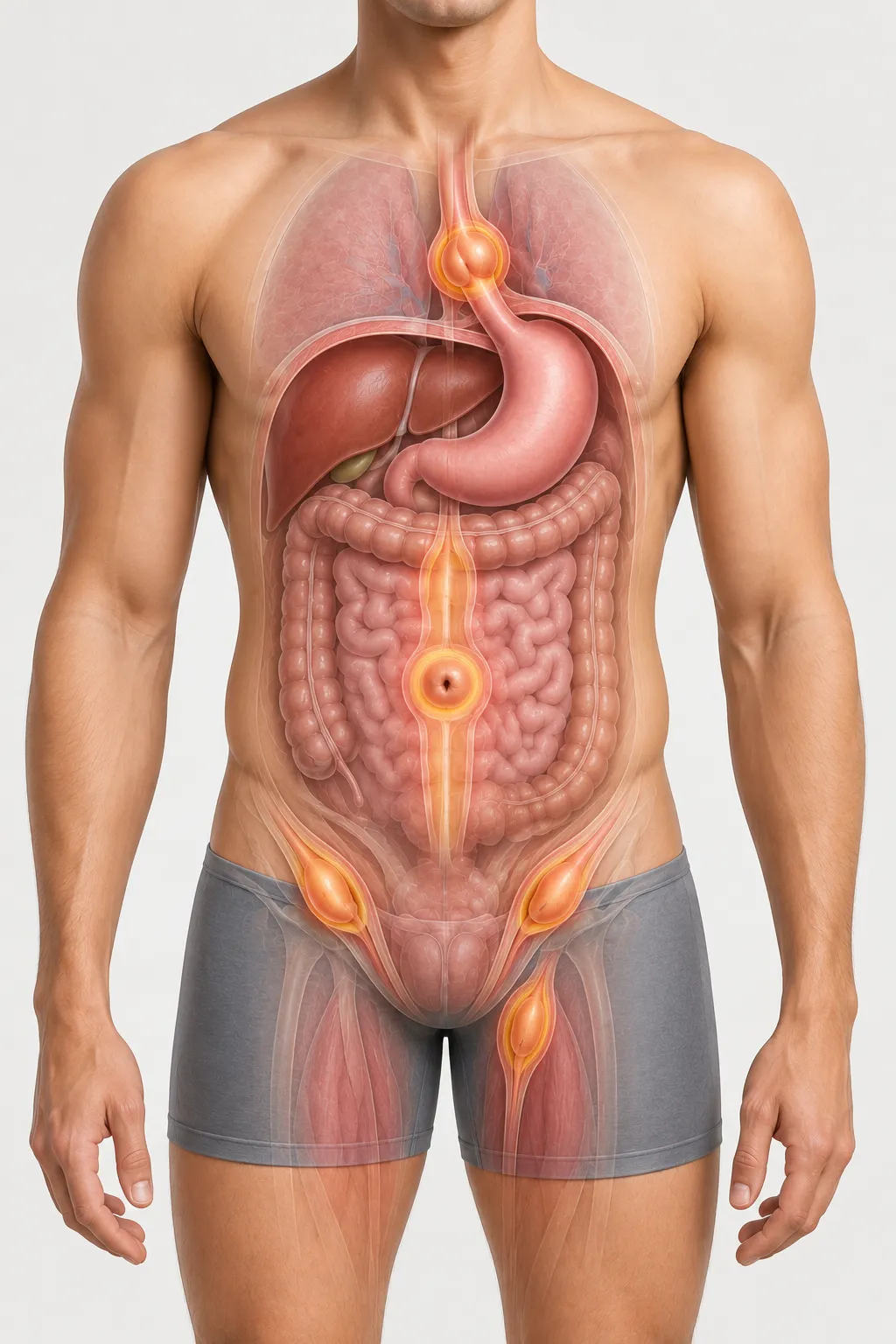
Hernias are essentially named after their location, since that location tells you a lot about the underlying cause and the muscle weakness involved. Broadly, doctors group them by:
- Location groin, abdomen, belly button, chest, or a previous scar
- Cause congenital (present from birth), acquired through strain or ageing, or arising after surgery
- Reducibility whether the bulge can be gently pushed back in, or whether it’s stuck (irreducible)
- Urgency whether it’s stable, or showing signs of strangulation, which needs emergency care
This classification isn’t just academic. It directly shapes whether your doctor recommends watching, wearing a support belt, or scheduling surgery soon.
Which Type of Hernia Is Not Serious?
A fair and honest question, because not every hernia carries the same weight of worry.
Generally, small, reducible hernias ones where the bulge easily pushes back in and causes little to no pain are considered less urgent. This often applies to:
- Small umbilical hernias in adults, particularly if painless and stable
- Early-stage inguinal hernias that are still small and easily reducible
- Hiatal hernias that are mild and mostly cause occasional acid reflux rather than severe symptoms
“Not serious” here means not urgent right now, not “ignore it forever.” Even a mild hernia is still a structural gap that typically won’t close on its own, and most will eventually need surgical repair. The lack of drama in the symptoms doesn’t mean the underlying issue has gone away.
The Main Types of Hernia
Here’s a full breakdown of the hernia types doctors see most often, along with what makes each one distinct.

1. Inguinal Hernia
The most common type by far, especially in men, an inguinal hernia occurs when tissue pushes through a weak spot in the groin area, near the inguinal canal.
It often presents as a bulge in the groin or upper thigh that worsens with standing, coughing, or heavy lifting. Left untreated, these tend to grow larger over time and carry a real risk of strangulation eventually.
2. Umbilical Hernia
An umbilical hernia develops when tissue protrudes through the abdominal wall near the belly button. It’s common in infants, where it often closes on its own by age 4 or 5, but adult umbilical hernias frequently linked to obesity, pregnancy, or repeated straining usually need surgical repair, since they don’t resolve naturally in adults.
3. Incisional Hernia
This type forms at the site of a previous abdominal surgery, where the muscle layer never fully regained its original strength. An incisional hernia can develop months or even years after the original operation, and tends to be more common in people who had complications during initial healing, or who strain that area with heavy lifting too soon after surgery.
4. Femoral Hernia
A femoral hernia occurs just below the groin crease, where tissue pushes through the femoral canal. It’s less common overall but occurs more frequently in women, particularly after pregnancy.
Femoral hernias carry a notably higher risk of strangulation compared to inguinal hernias, which is why doctors often recommend earlier surgical repair even when symptoms feel mild.
5. Hiatal Hernia
Unlike the others, a hiatal hernia occurs internally, when part of the stomach pushes up through the diaphragm into the chest cavity. Instead of a visible bulge, it typically presents through digestive symptoms heartburn, acid reflux, chest discomfort, or difficulty swallowing.
It’s often mistaken for simple acidity for months before being correctly diagnosed.
6. Recurrent Hernia
A recurrent hernia happens when a previously repaired hernia reappears at the same site, often due to excessive strain during recovery, weakened tissue, or in rare cases, a repair technique that didn’t hold as expected. These generally need a more careful, sometimes more complex, surgical approach than the original repair.
Which Type of Hernia Needs Surgery Immediately?
Some hernia types, or specific presentations of them, genuinely can’t wait for a routine appointment.
Surgery becomes urgent when:
- A hernia becomes strangulated the bulge turns firm, painful, and possibly discoloured, with the blood supply cut off
- A femoral hernia shows any sign of complication, given its higher baseline risk
- An incisional hernia suddenly enlarges or becomes acutely painful
- Any hernia is accompanied by fever, vomiting, or an inability to push the bulge back in
If any of these show up, this isn’t a “schedule it for next month” situation. It’s a same-day hospital visit. Among all types, femoral and strangulated hernias of any kind carry the sharpest urgency, since delayed treatment risks tissue damage that needs far more extensive surgery to correct.

Causes Specific to Each Hernia Type
While all hernias involve a weak spot in the muscle wall, what creates that weak spot varies:
- Inguinal: A naturally weaker area in the groin, often present from birth, aggravated later by heavy lifting or chronic strain
- Umbilical: Incomplete closure of the abdominal wall after birth, or weakening later from obesity, pregnancy, or repeated abdominal pressure
- Incisional: Incomplete healing of the muscle layer after prior surgery, often worsened by infection or strain during recovery
- Femoral: A naturally narrow femoral canal, more vulnerable to pressure, particularly after pregnancy
- Hiatal: Weakening of the diaphragm opening, often linked to age, obesity, or chronic pressure from coughing or straining
- Recurrent: Tissue that didn’t fully regain strength after a previous repair, or excess strain during the recovery period
Recognising your specific cause helps guide not just treatment, but also how to reduce the risk of a repeat hernia after repair.
How Doctors Diagnose Different Hernia Types
Diagnosis varies slightly depending on the suspected type:
- Physical examination the first step for most external hernias (inguinal, umbilical, femoral, incisional), often confirmed by asking the patient to cough or strain
- Ultrasound useful for confirming size and location, especially for less obvious or early-stage hernias
- CT scan helpful for femoral or incisional hernias, or when planning a more complex surgical approach
- Endoscopy specifically used for hiatal hernias, examining the stomach and oesophagus directly
Most external hernias are diagnosed confidently through examination alone, while internal types like hiatal hernias typically need additional imaging to confirm.
Treatment Options by Hernia Type at Meyash Hospital, Hisar
At Meyash Hospital, Hisar, treatment is tailored specifically to the hernia type rather than following one universal approach:
- Inguinal and femoral hernias are typically repaired through minimally invasive laparoscopic surgery with mesh reinforcement, offering strong, durable results
- Umbilical hernias in adults are usually repaired surgically, often with mesh support depending on size
- Incisional hernias may require a slightly more tailored surgical plan, factoring in prior scar tissue and abdominal wall strength
- Hiatal hernias are managed medically when mild, or surgically when symptoms are significant or persistent
- Recurrent hernias are approached carefully, often requiring a different surgical technique than the original repair to ensure a lasting fix
The consistent priority across all types is a durable repair with minimal disruption to daily life during recovery.
How Dr. Yashpal Singla Approaches Different Hernia Types
Dr. Yashpal Singla treats each hernia type as its own case, rather than applying a one-size-fits-all plan. Factors like hernia location, size, whether it’s a first-time or recurrent hernia, and the patient’s overall health all shape the recommended approach.
This means patients get a treatment plan genuinely built around their specific hernia, along with clear expectations about the surgical technique, recovery timeline, and long-term outlook.
Which Types of Hernia Is Most Common in India?
Inguinal hernia remains, by a considerable margin, the most common type seen in India, particularly among men. Factors contributing to this include physically demanding occupational work, higher rates of chronic cough (linked to smoking and air quality), and a generally weaker natural inguinal region compared to some other populations.
Umbilical hernias also show up frequently, particularly among women following pregnancy, and incisional hernias are becoming more commonly diagnosed as abdominal surgeries themselves become more common.
Conclusion
Understanding the different types of hernia isn’t just useful trivia it genuinely shapes how urgently you should act and what kind of treatment makes sense for your specific case. Some hernias can be watched carefully for a while.
Others need attention far sooner than people realise. Getting the right diagnosis early is what turns an anxious, uncertain situation into a clear, manageable one.
CTA Section
Whatever type of hernia you’re dealing with, getting it correctly diagnosed is the first step toward lasting relief. Dr. Yashpal Singla at Meyash Hospital, Hisar offers expert, type-specific hernia treatment with advanced laparoscopic techniques. Book your consultation today.
FAQs
Q: Can all types of hernia heal without surgery?
No, a hernia won’t close on its own since it’s a structural gap in the muscle wall. Support belts and lifestyle changes can ease symptoms temporarily, but surgical repair remains the only definitive treatment.
Q: What are the 5 warning signs of all types of hernia?
The five key signs are a visible bulge, pain that worsens with strain, a dragging or heavy sensation, a bulge that disappears when lying down, and digestive symptoms like reflux for hiatal hernias.
Q: Can you have more than one types of hernia at once?
Yes, it’s possible, though not extremely common. Someone could have both an inguinal and umbilical hernia, for example. A thorough physical examination usually catches multiple hernias if they’re present.
Q: Which types of hernia is most common in women?
Femoral and umbilical hernias occur more frequently in women compared to men, often linked to pregnancy and childbirth. Inguinal hernias, while more common in men overall, still occur in women too.
Q: Do all types of hernia need mesh repair?
Most adult hernia repairs use mesh reinforcement for a stronger, more durable result, especially for inguinal, femoral, and larger umbilical hernias. Smaller defects or specific cases may occasionally be repaired without mesh.
Q: Is all types of hernia treatment covered under cashless insurance at Meyash Hospital?
Hernia treatment and surgery are commonly covered under most health insurance plans, with cashless facilities available depending on the insurer. It’s best to confirm your specific policy details with the Meyash Hospital, Hisar team directly.
This article has been reviewed by the medical team at Meyash Hospital, Hisar. For personalized advice, consult Dr. Yashpal Singla or our specialists directly.